The name Ghana means warrior king. It is called the Gateway to Africa because it is often the first country newcomers to the continent visit. It is one of the safest destinations in all of Africa and the people are friendly and welcoming.
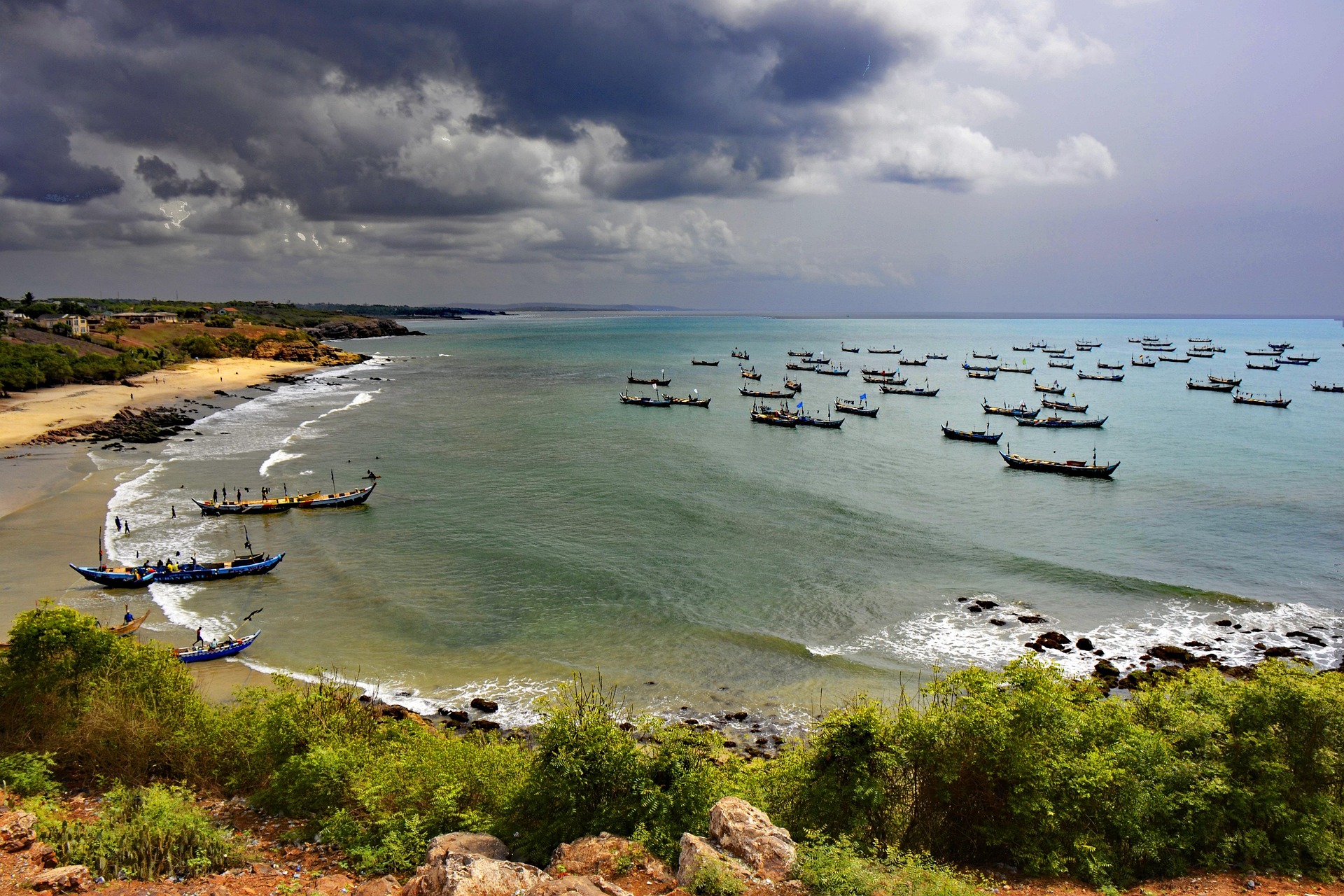

The name Ghana means warrior king. It is called the Gateway to Africa because it is often the first country newcomers to the continent visit. It is one of the safest destinations in all of Africa and the people are friendly and welcoming.
The port city of Accra is the seat of the government and commercial hub of Ghana. Travel with us to explore the post-colonial country of Ghana on the West Coast of Africa. It’s more than mere sightseeing, it’s an engaging experience to behold. Experience famed Ghanaian cuisine featuring cassava, beans, maize, plantain, rice, and yams. The spices, culture, and love that go into preparing each meal will keep you asking for more.
Come with us to hear the drumbeats and witness the dancing. You will see the national parks, wildlife, waterfalls, mountains, caves, and white-sand beaches. Partake in the joy, the culture, and the traditions. Visit street markets to shop for handicrafts and enjoy delicious street foods and snacks! Come with the expectation of being welcomed in the tropical paradise of Ghana! Watch the Ghana Chronicles, a mini documentary about Ghana: The Gateway to Africa Experience.


Choose a destination below to view all upcoming availibility. Click a date to see full journey details and secure your spot.


The only practical way to travel quickly to Ghana from outside of West Africa is by air. There is no national carrier but Airlines scheduled flights to Accra include British Airline, Emirates, Delta, Ethiopian Airlines and KLM.
Please be advised, Avoid flying to Ghana on one way ticket, for one, you may hit serious problem with Airport immigration official if you don’t arrive on a return ticket .And when you decide to return home, you’ll find the flight out of Accra very expensive. So you’ll almost certainly end up paying double that what would for a cheap return.
A Ghanaian Visa is basically permission given to visit and submit yourself for entry into Ghana. It should be noted that getting a visa does not ensure entrance into Ghana because it is subject to regularization and other requirements being met at the point of entry.
You must choose the number of entries and the visa processing service needed during the online visa application process. You can only pay the visa fees online with a credit or debit card. The processing of standard visas requires 15 business days, and it takes 5-7 business days for expedited services.
To avoid delays, we advise clients to submit their passports, completed visa application forms, and supporting documents well ahead of the planned departure date. The Ghana Visa for US citizens is valid for a maximum of 3 months from the date the visa is issued. Note that multiple entry visas and other visa types will be valid for varied periods. All visas applications must be completed online at the Ghana Consulate.
The attention of clients is drawn to the fact that their presence is required at the airport two hours before the scheduled departure time. Most companies close their check-in counters 45 minutes before departure time. Once you have checked in, it is also advisable to go immediately to the boarding gates, as police formalities may take a long time if several take –offs are scheduled at short intervals. Arriving passengers must count an average of 30 to 40 minutes to complete the formalities of police and customs and to retrieve their luggage.
Of course NO! As per our Tour package Transfers to/from Airport to the Lodge’s are inclusive what you need to do is to share your full flight details with us so that we can arrange it accordingly.
Maximum Impact Travel will be providing hotel accommodation according to the itinerary program. The client’s who will arrive earlier than the started safari dates or wish to extend their stay will be required to pay for the extra cost.
The Government of Ghana has lifted all COVID-19 travel restrictions.
If you take prescription medication, you’re responsible for determining their legality in Ghana. Bring sufficient quantities of your medication with you. Always keep your medication in the original container, Carry a copy of your prescription(s) also, remember Pack them in your carry-on luggage.
It’s recommended that travelers going to Ghana take prescription medicine to prevent malaria. Depending on the medicine you take, you will need to start taking this medicine multiple days before your trip, as well as during and after your trip. Talk to your doctor about which malaria medication you should take.
Travelers with physical disabilities and those who require frequent or on-going medical attention should advise Maximum Impact Travel of their health situation at the time of booking (or at the time such a situation occurs should this be after the reservation is made).
White clothing is not recommended because it is impossible to keep clean. Ghana is a very dusty place.
The currency of Ghana is the Ghanaian cedi (GHS). There are no restrictions on the import and export of foreign currencies. They must be declared upon arrival and exchanged for local currency at banks or foreign exchange bureaus only. Upon arrival, you will receive an Exchange Control Form T-5.
Yes and no. Most of the ATMs are located at the banks and remain open until about 8 p.m. Other ATMs that are in shopping malls and service stations are open 24 hours a day.
Yes, all international hotels and most restaurants will accept credit cards but most local shops accept only cash in local currency. A select few will accept payment in US dollars.
There are many safe places where you can exchange currency: at most hotels, all banks and exchange bureaus and in the airport as well.
Big cities are mostly okay although even in Accra coverage is patchy. In Ghana you pay per megabyte and it is quite expensive. Any unused at the end of the day, month, week is lost. Also you will find that speeds are throttled in the evening and weekends. True broadband is only available in the big cities where there is a land line network. Elsewhere you have to use a SIM card connection.
Ghana is voltage 230 V and the voltage frequency is 50 Hz. If the voltage in your country is between 220V – 250V (as is in the Europe, Australia and most of Asia) you can use your equipment.
In Ghana, electrical sockets and plugs are type D or G. Type D has tree round pins in a triangular pattern and type G has tree rectangular pins in a triangular pattern.
Ghana is a highly multilingual developing nation in West Africa. It has a population of over 25 million people from different ethnic groups. Ghana has about 50 indigenous languages (Dakubu, 1996), and the major ones are Akan, Ewe, Ga, Dagaare, and Dagbani, with English as the official language
TIME ZONE: The western African country Ghana observes a single time zone, denoted as Greenwich Mean Time (GMT; UTC±00:00). Ghana shares this time zone with several other countries, including fourteen in western Africa where it was formerly known as Western Sahara Standard Time (WSST).
Ghanaian food is diverse. It is a product of its climate, its history and its people. Simply put, Ghanaian food consists of a lot of spicy soups and stews made with a lot of tomatoes, onions, pepper, ginger and a variety of indigenous spices. Stews are thick and are usually accompanied with starchy tubers like the West African yam, or plantains. Soups are light and accompanied with a variety of starchy swallows made from tubers like cassava, cocoyam or West African yam, plantains or corn. If we are not eating a swallow or starchy tuber, we are eating rice. Plain rice, jollof rice, waakye, agwa mu, fried rice; the list goes on and on.
It’s not safe to drink tap water in Ghana. In fact, many in Ghana still lack access to clean drinking water and safe sanitation. We recommend use of bottled water.
Ghana has a tropical climate with daily temperatures ranging between 25 and 35 degrees Celsius (77 and 95 degrees Fahrenheit). It can be very humid at times, but there is always the sea breeze which ensures that there is a little refreshment.
Average daily temperatures range from 30°C (86°F) during the day to 24°C (75°F) at night with a relative humidity between 77 percent and 85 percent. In the southern part of Ghana, there is a bi-modal rainy season: April through June and September through November.
In Accra, the wet season is mostly cloudy, the dry season is partly cloudy, and it is hot and oppressive year round. Over the course of the year, the temperature typically varies from 74°F to 91°F and is rarely below 73°F or above 93°F.
Average Temperature in Accra
The hot season lasts for 5.8 months, from November 17 to May 11, with an average daily high temperature above 89°F. The hottest month of the year in Accra is March, with an average high of 91°F and low of 79°F. The cool season lasts for 2.2 months, from July 3 to September 9, with an average daily high temperature below 83°F. The coldest month of the year in Accra is August, with an average low of 75°F and high of 82°F.
Clouds
In Accra, the average percentage of the sky covered by clouds experiences significant seasonal variation over the course of the year. The clearer part of the year in Accra begins around June 27 and lasts for 7.5 months, ending around February 11.
The clearest month of the year in Accra is December, during which on average the sky is clear, mostly clear, or partly cloudy 56% of the time. The cloudier part of the year begins around February 11 and lasts for 4.5 months, ending around June 27.
The cloudiest month of the year in Accra is May, during which on average the sky is overcast or mostly cloudy 83% of the time
Precipitation
A wet day is one with at least 0.04 inches of liquid or liquid-equivalent precipitation. The chance of wet days in Accra varies very significantly throughout the year. The wetter season lasts 6.8 months, from April 2 to October 29, with a greater than 37% chance of a given day being a wet day. The month with the most wet days in Accra is June, with an average of 19.7 days with at least 0.04 inches of precipitation. The drier season lasts 5.1 months, from October 29 to April 2. The month with the fewest wet days in Accra is January, with an average of 0.9 days with at least 0.04 inches of precipitation.
Among wet days, we distinguish between those that experience rain alone, snow alone, or a mixture of the two. The month with the most days of rain alone in Accra is June,
with an average of 19.7 days. Based on this categorization, the most common form of precipitation throughout the year is rain alone, with a peak probability of 72% on June 7
Rainfall
To show variation within the months and not just the monthly totals, we show the rainfall accumulated over a sliding 31-day period centered around each day of the year. Accra experiences extreme seasonal variation in monthly rainfall.

The more details you share, the better we can create a journey that's truly personal and impactful.