

Choose a destination below to view all upcoming availibility. Click a date to see full journey details and secure your spot.


Air Senegal is the national airline, and you can use their services to travel to the country from several major cities in Europe and Africa. The main airlines that offer international flights to Senegal are:
Direct flights are available from various cities, such as Paris, Madrid, Lisbon, Verona, and New York. Dakar Airport is the main entry point, and from Dakar, you can take domestic flights to Saint Louis or other destinations in the country.
Renting a car in Senegal
You can rent a car to explore the country if you prioritize your autonomy. Many car hire companies offer different car options so you can choose according to your comfort requirements and budget. However, keep in mind that Senegalese roads require extra caution as traffic can be chaotic in major cities, and you may face roads in bad condition in the countryside.
Taxis in Senegal
There are a few different taxi services: normal taxi, motor taxi, and bush taxi. Yellow car taxis in Dakar are readily available 24/7, and they’re generally the safest and most reliable transport option. Once you and your driver agree on the price, your driver will get you there fast and securely. Motor taxis are cheap and can avoid traffic jams, but can be dangerous.
Bush taxis are the brightly decorated mini buses used mainly by locals. They only depart whenever it’s full, so departure and arrival times can be hard to predict.
Express trains in Senegal
You cannot count on a rail network to travel around Senegal. However, there is an express train that serves Dakar and the surrounding suburbs. This new public transport option was introduced in 2022, offering safer and faster transportation in the city, although it is more expensive than the usual mini buses.
Boat travel in Senegal
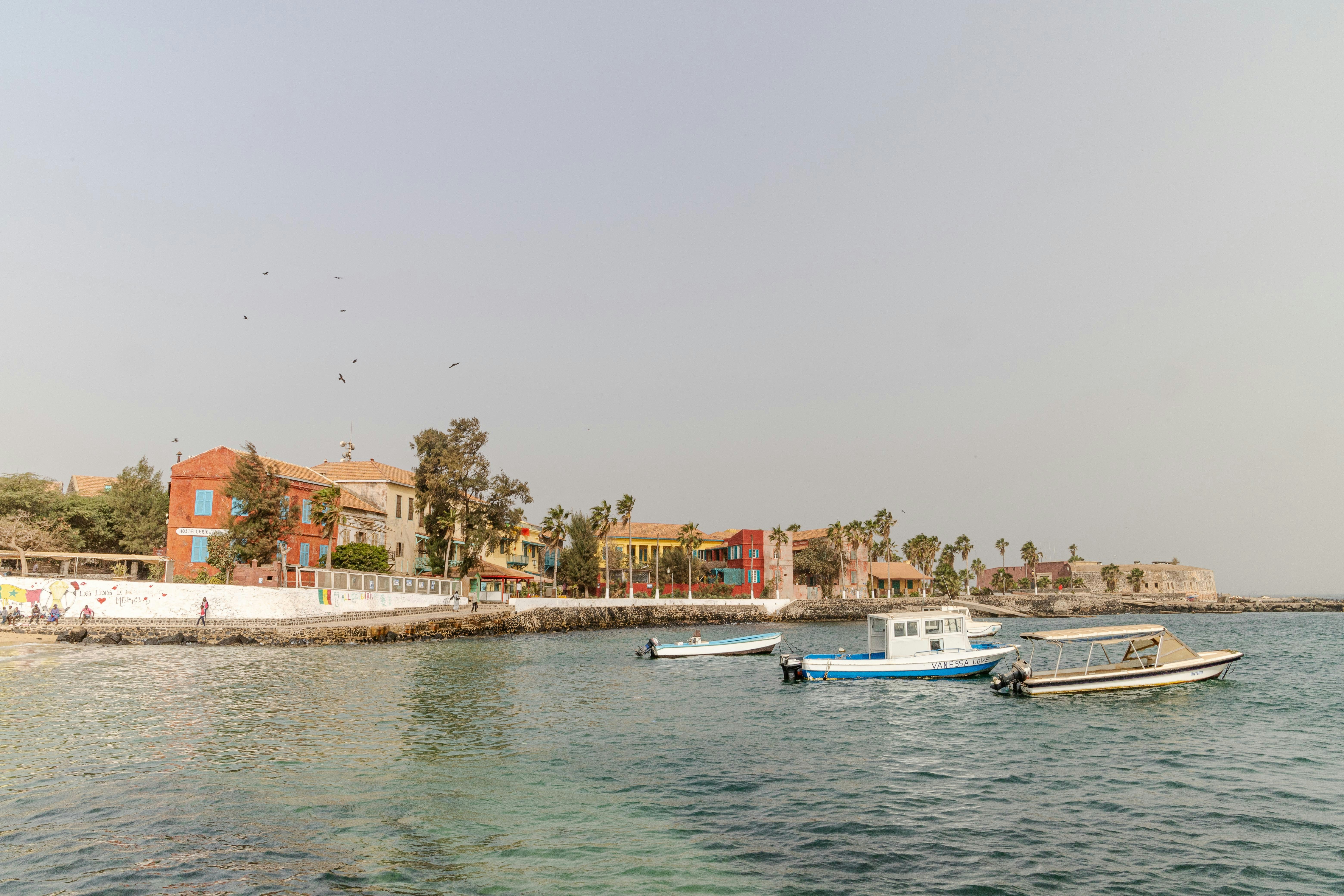
There are ferries going from Dakar to destinations such as Ziguinchor or Île de Gorée. We also recommend doing a cruise on the Senegal river. Many local tour companies offer this service, whether for big tourist groups or in small boats. It’s an excellent option to explore the region and learn about Senegalese history from local guides.
Buses in Senegal
Senegal has an extensive long-distance bus network, and offers comfortable and modern buses. Each bus company has its own bus station. In addition, bush taxis are another option to get around the country. These mini buses are slow and unpredictable, but cheap.
Safety in Senegal
Senegalese people are very friendly, and you will feel welcome in this unique country. However, it’s essential to be cautious and alert regarding security. Here are some travel tips:|
All visitors must either hold a return or onward ticket and all documents for the next destination. Passports must be valid for at least three months on entry; however, it is highly recommended that passports have at least six months’ validity remaining after the intended date of departure from Senegal. Immigration officials sometimes apply different rules to those stated by travel agents and official sources.
HOW TO OBTAIN A VISA
E-Visa online procedure: Senegal has established since 2013 the obligation to obtain a biometric visa for travelers of nationalities who were hitherto exempted. The visa procedure is quite complicated and happens in two stages. At first, the payment of the visa (50€) and of the cost of delivery shall be made on the dedicated website ( www.visasenegal.sn ). A number of information must be provided online. Online Visa process in Senegal: https://pickvisa.com/visa-policies/senegal-visa#13252.56245
Entry requirements
US nationals must have a passport valid for a minimum of six months beyond the period of intended stay. No visa is required for a maximum stay of up to 90 days.
UK nationals must have a passport valid for a minimum of three months from the date of arrival. No visa is required for a maximum stay of up to 90 days.
Canadian nationals must have a passport valid for a minimum of six months after their departure date. No visa is required for a maximum stay of up to 90 days.
Australian nationals must have a passport valid for a minimum of three months from the date of arrival. A visa is required for stays longer than 3 months.
South African nationals must have a passport valid for a minimum of three months from the date of arrival. A visa is required for stays longer than 3 months.
Irish nationals must have a passport valid for a minimum of three months from the date of arrival. No visa is required for a maximum stay of up to 90 days.
New Zealand nationals must have a passport valid for a minimum of three months from the date of arrival. A visa is required for stays longer than 3 months.
The attention of travelers is drawn to the fact that their presence is required at the airport two hours before the scheduled departure time. Most companies close their check-in counters 30 minutes before departure time. Once registered, it is also advisable to immediately go to the boarding lounge for police formalities that can be long if several departures are planned. Arriving passengers must count an average of 30 to 45 minutes to complete the formalities of police and customs and to retrieve their luggage.
Baggage Airlines are particularly demanding on the allowed weight of luggage. To avoid problems at check-in counters, it is expressly required for travelers to check before their arrival at the airport if their baggage does not exceed the permitted allowance. In this case, expensive and non-negotiable luggage fees may be asked. In addition, it is recalled that the luggage must be strong enough to be handled and transported. Plastic bags are prohibited because they tear easily.
Of course NO! As per our Tour package Transfers to/from Airport to the lodge’s are inclusive what you need to do is to share your full flight details with us so that we can arrange it accordingly.
Maximum Impact Travel will be providing hotel accommodation according to the itinerary program. The client’s whose will arrive earlier than the started safari dates or wish to extend their stay they will be required to pay for the extra cost to the respectively hotels/Lodges.
Yellow fever – There is a risk of Yellow Fever in Senegal. Yellow fever vaccination certificate is required for travelers over 9 months of age arriving from countries with risk of yellow fever transmission and for travelers having transited more than 12 hours through the airport of a country with risk of yellow fever transmission.
COVID 19 – COVID-19 vaccination passports or certificates are not mandatory to enter Senegal. Note that recognized vaccines in Senegal are AstraZeneca, Pfizer, Johnson & Johnson, Moderna, Sinopharm, and Sinovac. You are considered vaccinated if all doses of a vaccine against SARS-Cov-2 have been administered for at least two weeks before traveling. Since information may change quickly, we advise you to follow up on the latest Senegal travel updates and/or contact your local embassy.
Malaria – You will need to take prescription medicine before, during, and after your trip to prevent malaria. Your doctor can help you decide which medicine is right for you, and also talk to you about other steps you can take to prevent malaria. Areas of Senegal with risk of malaria: All. See more detailed information about malaria in Senegal.
Please be advised, Keep medicines in their original, labeled containers. Ensure that they are clearly labeled with your full name, health care provider’s name, generic and brand name, and exact dosage. Bring copies of all written prescriptions, including the generic names for medicines.
Travelers with physical disabilities and those who require frequent or on-going medical attention should advise Maximum Impact Travel of their health situation at the time of booking (or at the time such a situation occurs should this be after the reservation is made).
Be aware, that in Senegal - Casamance and also Guinea-Bissau, Dollars are not really accepted as payment. If at all, the exchange rate is horrible. Even Hotels don’t accept dollars. Even credit cards are mostly not accepted anywhere. ATM in Banks are mostly empty. Urgent advice: bring cash Euro or change or get CFA at big banks, before you go into the countryside.
There are ATMs throughout Senegal and fairly widespread across Dakar. However check if they accept foreign cards first.
Credit cards: Major credit cards such as Visa, Master card, and Amex are accepted in Senegal, especially at shops and restaurants.
Money charger can be found throughout Senegal, with exchange rates generally more favorable at the border points. However, keep your money safe and watch out for scam.
Internet service is widely available in Dakar and other towns either by private subscription or through Senegal’s extensive network of “telecentres” and Internet cafés.
Electrical current is 220 volts, 50Hz. Round two-pin attachment plugs are in use.
French is the official language .Additionally, Wolof, Sereer, Pulaar, Joola,Malinke,and Soninke are recognized as national languages.
TIME ZONE: Greenwich Mean Time (GMT±00:00).
Senegal’s food is considered among the best in Africa, with unmistakable influences from French and Moroccan cuisine. Rice is the main staple, often served with chicken or fish. Senegal is a Muslim country so pork is rare but alcohol is available. Peanut is the main crop in the Senegal. The aroma of the roasted peanut fills the air, while peanut paste is widely used in strew, infusing a distinctive taste to local dishes.
Typical Senegalese food to try
Thiéboudieune – This is a traditional dish made of rice cooked with tomato sauce and nokos, a mixture of spices and herbs. After that, the same tomato sauce is used for cooking fish and many different vegetables, such as carrots, cabbage, cassava, eggplant, okra, and turnip. They are served together.
Soup Kandia – Most restaurants in Senegal have this dish on the menu. It’s a stew of okra, palm oil, fish, and white rice. For a good kandia soup, it’s essential to count on quality ingredients, such as meaty fish and juicy okra.
Domoda – This dish can be made with beef, veal, lamb, or fish. The meat is cooked in a sauce of tomato paste, onions, vegetables, and lots of lemon. Next, the sauce is thickened with flour and a water paste.
In short: buy bottled. Tap water is fine for cooking, washing vegetables, boiling a cup of tea or coffee and brushing one’s teeth, but when it comes to drinking, it’s best to stick to bottled water (although don’t panic if you accidently glug a glass of tap water).
Senegal is located in Sahelian West Africa. There are two distinct seasons, the rainy season (May to November) during which it is very hot across the country and very humid in areas closer to the coastline. And a cooler dry season (December to April) during which there are significant harmattan winds and most areas across the country experience dust storms. Temperatures in Senegal range from evening lows of 60-85 degrees Fahrenheit throughout the year to daytime highs of 80-100+ degrees Fahrenheit. Senegal’s proximity close to the equator also means that the intensity of the sun is especially noticeable.
The best time to visit Senegal is from November to mid-February. It is dry and during this period you avoid the worst heat. If you just want to visit the beaches of Senegal you could go from October to April.
Weather in January
The weather conditions in Senegal in January vary from tolerable to perfect depending on the destination.
During January in Senegal the average maximum daytime temperatures are very high and range from 31°C (88°F) in Dakar to 35°C (95°F) in Tambacounda. Minimum nighttime temperatures generally drop to 18°C (64°F) in Tambacounda and 16°C (60°F) in Dakar. On average, it is the month with the lowest temperatures of the year in Senegal.
January is a very dry month with an average rainfall of around 0.6mm (0 inches) in Dakar. It is also generally a sunny time of year with an average of 245 hours of sunshine in Dakar during the entire month.
Weather in February
During February in Senegal the average maximum daytime temperatures are very high and range from 32°C (89°F) in Yof to 38°C (100°F) in Tambacounda. Minimum nighttime temperatures generally drop to 20°C (67°F) in Tambacounda and 16°C (61°F) in Yof. These night and day temperatures are average and some days may be even warmer. So be prepared and dress for the heat. February is a very dry month with an average rainfall of around 0.5mm (0 inches) in Dakar. It is also generally a sunny time of year with an average of 244 hours of sunshine in Dakar during the entire month.
Weather in March
During March in Senegal the average maximum daytime temperatures are very high and range from 33°C (91°F) in Dakar to 40°C (105°F) in Tambacounda. Minimum nighttime temperatures generally drop to 22°C (72°F) in Tambacounda and 17°C (63°F) in Dakar. These night and day temperatures are average and some days may be even warmer. So be prepared and dress for the heat. March is a very dry month with an average rainfall of around 0.2mm (0 inches) in Dakar. It is also generally a sunny time of year with an average of 285 hours of sunshine in Dakar during the entire month.
Weather in April
During April in Senegal the average maximum daytime temperatures are very high and range from 33°C (91°F) in Yof to 42°C (108°F) in Matam. Minimum nighttime temperatures generally drop to 25°C (77°F) in Matam and 18°C (64°F) in Yof. These night and day temperatures are average and some days may be even warmer. So be prepared and dress for the heat. April is a very dry month with an average rainfall of around 0.2mm (0 inches) in Dakar. It is also generally a sunny time of year with an average of 288 hours of sunshine in Dakar during the entire month.
Weather in May
During May in Senegal the average maximum daytime temperatures are very high and range from 32°C (90°F) in Yof to 43°C (110°F) in Matam. Minimum nighttime temperatures generally drop to 28°C (82°F) in Matam and 19°C (67°F) in Yof. These night and day temperatures are average and some days may be even warmer. So be prepared and dress for the heat. Precipitation in May varies from almost none in Dakar with an average of 0mm (0 inches) of rainfall to low in Tambacounda with 22mm (0.9 inches). It is the driest month of the year in Dakar. It is also generally a sunny time of year with an average of 291 hours of sunshine in Dakar during the entire month.
Weather in June
During June in Senegal the average maximum daytime temperatures are very high and range from 33°C (91°F) in Dakar to 41°C (106°F) in Matam. Minimum nighttime temperatures generally drop to 28°C (82°F) in Matam and 22°C (72°F) in Dakar. These night and day temperatures are average and some days may be even warmer. So be prepared and dress for the heat. Precipitation in June varies from low in Saint-Louis with an average of 12mm (0.5 inches) of rainfall to high in Cap Skirring with 124mm (4.9 inches). It is also generally a sunny time of year with an average of 252 hours of sunshine in Dakar during the entire month.
Weather in July
During July in Senegal the average maximum daytime temperatures are very high and range from 31°C (88°F) in Cap Skirring to 37°C (99°F) in Matam. Minimum nighttime temperatures generally drop to 26°C (78°F) in Matam and 24°C (74°F) in Cap Skirring. On average, it is the warmest month of the year in Senegal. So be prepared and pack summer clothes. Precipitation in July varies from moderate in Saint-Louis with an average of 50mm (2 inches) of rainfall to heavy in Cap Skirring with 323mm (13 inches). It is also generally a sunny time of year with an average of 233 hours of sunshine in Dakar during the entire month.
Weather in August
During August in Senegal the average maximum daytime temperatures are very high and range from 30°C (86°F) in Cap Skirring to 35°C (94°F) in Matam. Minimum nighttime temperatures generally drop to 25°C (77°F) in Matam and 23°C (74°F) in Cap Skirring. These night and day temperatures are average and some days may be even warmer. So be prepared and dress for the heat. Precipitation in August varies from high in Saint-Louis with an average of 118mm (4.7 inches) of rainfall to heavy in Cap Skirring with 481mm (19 inches). It is the wettest month of the year in Dakar. It is also generally a sunny time of year with an average of 223 hours of sunshine in Dakar during the entire month.
Weather in September
During September in Senegal the average maximum daytime temperatures are very high and range from 31°C (88°F) in Cap Skirring to 36°C (96°F) in Matam. Minimum nighttime temperatures generally drop to 25°C (76°F) in Matam and 23°C (74°F) in Cap
Skirring. These night and day temperatures are average and some days may be even warmer. So be prepared and dress for the heat. Precipitation in September varies from high in Saint-Louis with an average of 106mm (4.2 inches) of rainfall to heavy in Cap Skirring with 354mm (14 inches). It is also generally a sunny time of year with an average of 219 hours of sunshine in Dakar during the entire month.
Weather in October
During October in Senegal the average maximum daytime temperatures are very high and range from 33°C (91°F) in Cap Skirring to 38°C (101°F) in Matam. These night and day temperatures are average and some days may be even warmer. So be prepared and dress for the heat. Precipitation in October varies from low in Saint-Louis with an average of 24mm (0.9 inches) of rainfall to high in Cap Skirring with 123mm (4.8 inches). It is also generally a sunny time of year with an average of 257 hours of sunshine in Dakar during the entire month.
Weather in November
During November in Senegal the average maximum daytime temperatures are very high and range from 33°C (92°F) in Cap Skirring to 37°C (99°F) in Matam. These night and day temperatures are average and some days may be even warmer. So be prepared and dress for the heat. Precipitation in November varies from almost none in Saint-Louis with an average of 0.1mm (0 inches) of rainfall to low in Cap Skirring with 11mm (0.4 inches). It is also generally a sunny time of year with an average of 249 hours of sunshine in Dakar during the entire month.
Weather in December
During December in Senegal the average maximum daytime temperatures are very high and range from 32°C (89°F) in Dakar to 35°C (95°F) in Tambacounda. These night and day temperatures are average and some days may be even warmer. So be prepared and dress for the heat.
December is a very dry month with an average rainfall of around 0.2mm (0 inches) in Dakar. It is also generally a sunny time of year with an average of 239 hours of sunshine in Dakar during the entire month.

The more details you share, the better we can create a journey that's truly personal and impactful.


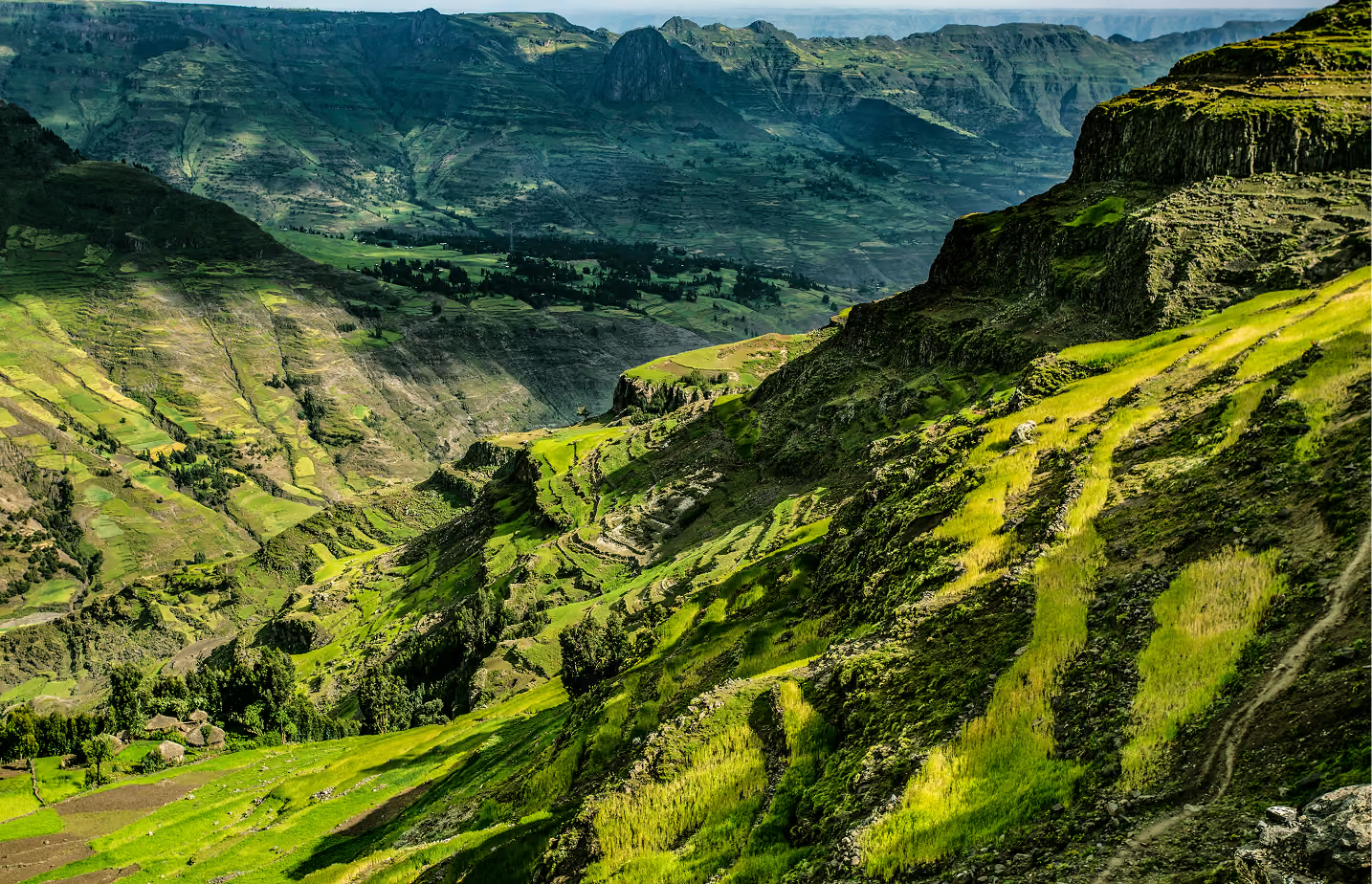
Ancient history, delicious cuisine, and smiling faces await you in Ethiopia. Get to know this East African nation on the Horn of Africa. A rugged, landlocked country split by the Great Rift Valley. With archaeological finds dating back more than 3 million years, it’s a place of ancient history and rich culture.